Thursday, March 28, 2013

Lingering Snow Keeps Parsnips Out-Of-Bounds


Parsnips. You either love them or hate them. I’ve never met anyone who was simply ambivalent about parsnips.

As for me, I love them and plant them in my garden every year. But instead of harvesting them in fall, along with carrots, my parsnips spend the fall and winter in the ground. This greatly increases their sugar content. Then, the following spring when the ground thaws, my parsnips are extra-sweet and delicious.

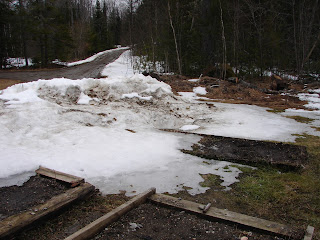
And right now in late March, it’s time to pull my parsnips. But I can’t, because they are covered by a huge pile of snow. My garden plot makes a convenient place for the snow plow man to use as a “push-off,” or place where he can dump loads of snow after making a long, straight run. I’ve tried to discourage him from this habit, but he has a standard retort. “I’ve got nowhere else to put it.” It’s hard to argue with that kind of logic.

So my parsnips remain out-of-bounds for the foreseeable future, so near and yet so far.

On to another garden vegetable topic, I recently checked out Mike Webber’s blog in the online version of the Bangor Daily News. There, I saw a familiar-looking photo, along with a title that said something about due apologies to Tom. I clicked on the header and went to the full-length blog.

Mike had read one of my past blogs, one that I had named, “Chives Alive.” Mike posted a photo of his own chive patch, with the little green onion-like tops poking up out of newly-thawed ground. “Chives Arrive,” he called his post, thus the apology to me.

Mike, if you read this, you must know that I consider imitation the sincerest form of flattery. You go ahead and copy me any time. I’m honored.

By the way, Mike, did you plant parsnips last year and leave them in the ground all winter, as I did? If so, are you able to pull them yet?

Here’s to all of us who dearly want for winter to go away for good. Let’s agree that sunny, warmer days lie just ahead. And of course, if anyone wants to keep in shape by shoveling snow, I know of a big pile of it that needs removing.


Tuesday, March 19, 2013

Winter Wears Out Its Welcome


Why do people typically become frustrated and put out when winter conditions linger into spring, but when summer-like conditions persist into late fall, we welcome them?

This current snowstorm, for instance, coming on the last day of winter, seems terribly out of place, as does the below-normal temperatures of the past week. And to think, I planted lettuce and radishes in the in-ground-beds inside my greenhouse and now, the soil has frozen solid. I’ll have to replant when it finally warms up.

“Hope deferred makes the heart sad.” That’s what a famous proverb says. And boy, have we seen hope deferred. To think, that one year ago we here in Maine were reveling in temperatures in the mid-70s. And today we have snow, wind and temperatures in the teens.

I just read a statement from a weather guru with the National Weather Service. He said that this could possibly be the last big snowstorm of the season, but not to count on it. The same conditions that have prevailed for most of the winter continue, with no big change in sight.

In another instance of hope deferred, amateur astronomers throughout the northeast were handed a very attractive carrot, only to have it snatched away at the last minute. That carrot was Comet PanSTARRS. The comet was to be a naked-eye object low in the west beginning around March 8 and lingering until around March 18.

Like so many others, I had my viewing place all lined up ahead of time. It’s hard to find an unobstructed view to the west, what with all the trees. But a nearby farm on a hill provided just the perfect location. And the farm family happily gave me permission to come and watch the comet. They even came out and watched with me. But we saw no comet, only clouds.

I made multiple trips to the hill, only to find low-lying clouds covering the spot where the comet supposedly sat. And now, according to what I read, the comet has risen higher but dropped in magnitude, meaning that finding it will come much harder and will require a telescope. Hops of seeing it with the naked eye or in binoculars were dashed. And this particular comet will never visit our region again. It was just one of those things. Hope deferred.

Warm weather will return and so will clear skies. Ice will melt, snow will stop falling and flowers will bloom and fish will bite. But for now, that all seems so far away. But we have no alternative than to wait, with patience. 

Sunday, March 10, 2013

Daylight Saving Time


Some Thoughts On Daylight Saving Time

Daylight Saving Time (DST) intrudes upon our lives in many ways. And whether we like it or not, as with the weather, we can do nothing about it.

While many people credit Benjamin Franklin (indeed, I once believed this) with first devising DST, Franklin had nothing to do with it. Instead, the dubious honor goes to Englishman William Willett, who in 1907, proposed pushing clocks ahead one hour. Willett was a golfer and the extra hour of daylight would give him more time on the links. Talk about vested interests.

Willet’s idea did not fly, at least not immediately. But when World War I broke out, a number of countries, including the United States, embraced the time change for the sake of saving energy and also to give people more time to plant and maintain vegetable gardens. After the war, DST was dropped and re-adopted and dropped and then reinstated during World War II. Then in 1966, Congress declared it official and we have had it ever since.

Since then, the onset of DST has slowly inched forward. It seems to me that in my youth, DST began the last Saturday in April. Then at some point, as I recall, or should I say unless lack of sleep has made my memory faulty, it was moved to late March. Now it has moved forward to the second Sunday in March. Where will it stop? We have only 24 hours in a day and if left unchecked, these periodic extensions will begin where we left off. I’m only half kidding here.

Sleep is a dear commodity, one that many people go to lengths to acquire. Not everyone sleeps well. As one who suffers occasional bouts with insomnia, I can attest that lost sleep causes much discomfort. And when changes, even small ones, occur to our established sleep patterns, it can cause great physical damage. Anything that upsets our natural biological rhythms has the potential to make us sick, perhaps very sick. And DST certainly upsets our biological rhythms.

And what about the supposed energy savings? Well, according to a blog by Kelly Beatty, the Department of Energy conducted an analysis of the cost-saving effects of booting DST ahead to early March. Their conclusion? “There might be an energy saving of 0.5 percent.” Note the word, “might.”

Furthermore, a University of California study found that when Indiana (a lingering DST holdout) adopted DST in 2006, their electricity bills immediately rose about 1 percent. And by late summer, that figure rose by 4 percent. That’s right. I said “rose,” not “dropped.”

So in this case and in fact, more than likely most cases, DST costs us energy.

Finally, according to Swedish scientists, besides disrupting our sleep patterns and making us tired, cranky and inefficient, DST may contribute to heart failure. DST causes increased risk of heart attacks.

Like its founder, Willett, I have a vested interest that has to do with DST. I am an amateur astronomer and since darkness now comes one hour later, it means staying up one hour later in order to observe the heavens. In summer, when full darkness doesn’t set in until well after 9 p.m., I often fall asleep before I can set up my telescope.

But it’s the sleep disruption that I dislike the most. I’ve tried ignoring DST, not setting my clocks ahead. But living a time-oriented society, this does not work very well. In the end, we all must conform to DST.

Maybe some day things will change. But don’t look for it anytime soon.


Wednesday, March 6, 2013

Comet PanSTARRS


Beginning on or about March 8, Comet PanSTARRS should become visible just above the western horizon shortly after sunset. At that point, it may be hard to spot without binoculars. After that, it should be a naked-eye sight.

Viewers from the southern hemisphere, who have been able to see the comet for a while now, report it having two tails. Additionally, the comet brightens in magnitude as time passes, meaning that by mid-March, we should have some excellent views of it here in Maine. After that, it fades and will only be available to those with powerful telescopes.

To spot PanSTARRS, go somewhere with an open view to the west, just after sunset. Look in the general area where the sun went down and find something like a star. This should be the comet. Binoculars will give a fine view and a telescope should give a remarkable view.

Of course all this hangs upon the weather, that bugaboo of amateur astronomers. The current spate of clouds and daily rain and snow showers does not bespeak of better things to come. It is vaguely possible that the comet will come and go without us getting much of a look at it.

This Saturday, March 9, is supposed to come on sunny and bright. If so, let us hope that the fine weather continues into the evening. After Saturday, weather folks are talking more lousy weather.

So if opportunity presents itself and conditions permit, I suggest taking a look at the first of the 2013 comets. I say the first, because a highly-rated comet is due late this fall. Stay tuned for more on that. But for now, check out PanSTARRS. 

Tuesday, February 26, 2013

Early Coltsfoot Cheers Winter-Weary Tom


It was a beautiful, warm morning today and come noon, I thought to celebrate by driving to the pound for a lobster. Going home on a back road near a tidal river, I spied a splash of yellow on a raw, steep roadside bank. I knew immediately that here, was blooming coltsfoot.

Stopping for a close look, I was pleased to see the bank covered with the dandelion-like, showy yellow blossoms. Coltsfoot is our earliest-blooming wildflower and usually shows up in early- to mid-April. Last year it appeared in mid-March. And in 2013, it bloomed on February 22, 2013.

So just when I was feeling most despondent over another impending snowstorm, these brilliant-yellow flowers cheered me and gave me to understand that while it may snow some more, spring is on the way.

For another sign, a friend from the Belgrade Region wrote me that two days ago, he sighted a pair of turkey vultures. These, too, are unusually early. Turkey vultures follow the retreating snowpack north. Usually, we don’t see these until some time in late March or early April, at the earliest.

So while unsettled weather may obscure the sun, make no mistake: The steady onset of spring has begun and will not retreat. It may stall, but that is of trifling concern. Spring marches forward. 

Friday, February 22, 2013

How To Beat The Winter Doldrums


Today is Friday, Feb. 22 and it’s a sunny, relatively warm day, nice for late winter. But spring still remains a few steps ahead of us. The National Weather Service has issued a winter storm warning for coastal Maine beginning Saturday evening and lasting through Sunday.

Of course the storm may change direction, ride out to sea. But probably not. We’ll no doubt get several more snowstorms yet this season. So while we remain locked in winter’s grip, there are several sources of solace. One, something I do each year, requires very little effort.

I refer to the venerable Swedish practice of cutting white birch branchlets and forcing them in a water-filled vase. It helps to flatten the butt ends of the branchlets, or twigs, in order to encourage them to absorb as much water as possible. Keep the vase filled and soon, lime-green leaves will unfurl, a little vignette of what we can expect in just a few, short months.

And then for those who live in places where snow has melted on south-facing banks, we have an opportunity to do some early-season foraging. Some plants, perennials, do just fine under their blanket of winter snow. Two of these, wintergreen and ground ivy, make pleasant, healthful, teas.

So if you know where either of these two plants grew last fall before the snow fell, head out there now and try and find some. Pick the leaves and go back in and make a tea. For wintergreen tea, use lots of wintergreen leaves, since it makes a fairly weak solution. Ground ivy produces a very bitter tea. It’s high in vitamin C, so if, like me, you enjoy bitters, you’ll appreciate ground ivy. The late Euell Gibbons enjoyed both of these refreshing teas.

Finally, if you have a south-facing window, remove your shirt, if practicable, and stand back-to in the sunshine. Then turn around, close your eyes and let the sun shine on your face. Benjamin Franklin made this practice a regular habit. He called it his “tonic bath.” Dr. Franklin may not have known about vitamins from sunshine, but he certainly understood the benefits of regular, limited exposure to the sun.

These are just some of the various ways to beat the winter doldrums and give the heave-ho to cabin fever. And just think, by doing these things, we are in good company, the likes of Benjamin Franklin and Euell Gibbons. I can’t think of two people whom I admire more.


Sunday, February 17, 2013

Cabin Fever 2013


This winter seems a long one to me, perhaps longer than usual. And though we only had two snowstorms worthy of mention in December and January, February saw a number of lesser storms, plus a major blizzard.

And the usual number of below-zero temperature days has extended well beyond the token six or eight that we usually see on any given year. Add it all up and we have something like an old-fashioned Maine winter.

As a young man, ice fishing was my favorite wintertime activity, along with hunting hares on snowshoes and cross-country skiing, just for fun. But now, these activities no longer hold my interest. It hurts my back to cut holes in the ice and besides that, it no longer seems fun to stand on the ice for hours on end jigging, or watching for flags.

So I’m ready for spring and look forward to the March 20 vernal equinox with great anticipation. And somewhere in the middle of March, I’ll begin my countdown to the opening day of trout fishing in brooks and streams. Thoughts of springtime activities keep me going now and all notion of wintertime pursuits have long ago vanished.

But that’s just me. Other people have far different agendas. Recently, while waiting to speak to an ATV/snowmobile dealer regarding a feature assignment I’m writing for an outdoor magazine, I overheard a telling conversation. It was unusually warm that day and a customer, a snowmobiler, was bemoaning the shrinking snowpack. The man behind the desk commiserated, adding that it was likely to put a big dent in his business.

Both of these people truly had legitimate gripes regarding a possible early arrival of spring. Of course I kept my mouth shut and even though the customer glanced at me, as if waiting for me to at least nod my head in agreement, I declined to comment. After all, my feelings tended toward the opposite direction. “Each to their own,” as the old lady said when she kissed a cow.

And today another snowstorm, complete with driving snow and high winds, keeps me inside, close to the woodstove. The scene outside could well portray a northern Canadian landscape rather than a rural clearing in Midcoast Maine. The nearness of spring does little to assure me that this won’t last. This feeling of hopelessness hits at the same time each year. Some call it “cabin fever.”

Of course nothing this side of a warm, sunny day will dispel the melancholy associated with cabin fever. Going out to dinner helped me briefly. I tire of my own cooking and so asked a friend to a local restaurant yesterday. We both needed to get out. But the mutual high we experienced from being out of our respective houses and around other people vanished within a few hours of returning home.

So now I’m going to lengths to “think spring.” To that end, I searched my photo library for a close-up shot of an English wood hyacinth, a sweet-smelling, dazzling blue flower spike that erupts in early spring. This cheery photo now serves as a background on my computer screen.

Also, I recently was given one of my old jobs back, that of home-and-garden columnist for The Republican Journal and also, the Camden Herald. I wrote this column for a number of years, but in 2008, an out-of-state company bought up the newspaper chain and instead of keeping old-time columnists and employees on, they brought in a new group of workers, their “own people,” as the new editor phrased it.

But that group went bankrupt last year. Luckily, a Maine-based publisher bought the newspaper chain and so many of the old-time writers are back, including me. And now, as not only a writer for the editorial page but also, a garden writer, I can fill my mind with thoughts of gardening, flowers, seed starting, lettuce, vegetable selection and a host of other happy thoughts. This does much to allay the ill effects of cabin fever.

All of these things help, of course. But one thing above all soothes my winter-weary soul. It comes in the form of a realization. Let me explain.

Each year about this time, I tell myself that there’s no way all the snow and ice will melt to the point that we can get out and about by April 1 (which, again, marks the opening day of trout fishing season on brooks and streams). And then lo and behold, April comes and it occurs to me that my fears were unfounded. This has happened for so many years in a row that just knowing the truth of it acts as an anodyne to winter woes.

So whatever winter brings, know that as surely as day follows night, things will change dramatically in one, short month. Take heart, you who yearn for spring. It’s on its way and nothing can stop it.